




Trapezoidal sheet load-bearing capacity: load limits & stable alternatives
The load-bearing capacity of trapezoidal sheets is a decisive factor for the safety and durability of your roof structure. As a planner or builder, you need to know the static limits precisely in order to avoid damage due to overloading. We explain the most important calculation principles and show you when high-performance alternatives are the better choice.
The correct assessment of structural properties requires sound specialist knowledge of material behaviour, load distribution and normative specifications. Errors in the structural analysis can lead to costly damage or even the risk of collapse.
Static principles: Calculation of trapezoidal sheets
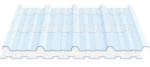
The structural calculation for trapezoidal sheets is based on the same principles as other steel components. Trapezoidal sheets act as bending-stressed beams whose load-bearing capacity depends on the profile geometry, the material thickness and the spans. The characteristic wave shape gives the thin steel sheet a significantly higher rigidity than a flat sheet.
You must take various failure cases into account in the static calculation: Bending, localised buckling, shear failure and support failure at the supports. The weakest link determines the maximum load-bearing capacity of the entire system.
Material thickness and profile geometry
The load-bearing capacity of trapezoidal sheets increases disproportionately with the profile height. A trapezoidal sheet with a profile height of 35 mm carries significantly less than one with a height of 135 mm. At the same time, the material thickness plays an important role: typical thicknesses are between 0.50 mm and 1.50 mm, with thinner sheets being more susceptible to localised buckling.
The profile geometry determines the section modulus and thus the bending strength. Trapezoidal profiles with wide webs and narrow beads offer a higher load-bearing capacity than profiles with narrow webs. The ratio of web height to web width also influences the risk of buckling.
Spans and support
The span width has an enormous influence on the load-bearing capacity, as the bending moments increase quadratically with the span width. A doubling of the span width leads to a quadrupling of the bending stresses. For this reason, the permissible span widths are strictly limited in the manufacturer's tables.
The type of support determines the static system: Simple support results in different moment curves than continuous support over several spans. Continuous trapezoidal sheets can absorb higher loads, as positive and negative moments partially cancel each other out.
Load tables: Apply snow load and wind load correctly
A load table for trapezoidal sheets provides you with quick information about the permissible loads for different spans. These tables are based on normative calculations and take all relevant failure modes into account. You will find both uniformly distributed loads and individual loads.
The snow load is often the decisive load, especially in snowy areas. Snow load acts as a uniformly distributed surface load and generates maximum span moments in the centre of the span. When calculating, you must take into account unusual snow accumulations and drifts.
Using load tables correctly
The application of a load table requires precise knowledge of the boundary conditions. You must select the correct profile, the correct material thickness and the corresponding static system. Interpolations between table values are only permissible for linear relationships.
Important parameters for table selection:
- Profile type and height
- Sheet thickness and steel grade
- Span and type of support
- Load distribution (uniform or concentrated)
- Safety coefficients according to the current standard
Consider wind load effects
Wind loads can occur both as pressure and suction loads. Wind suction generates tensile forces that attempt to lift the trapezoidal sheeting away from the substructure. The fixing distances must be dimensioned accordingly in order to safely transfer these tensile forces to the supporting structure.
The wind load calculation is carried out in accordance with DIN EN 1991-1-4 and takes into account the local wind conditions, terrain category and building geometry. Increased wind loads occur particularly at building edges and corners due to flow separation.
For detailed information on snow load calculation, please visit our Calculate snow loadpage .
Static calculation in practice
The practical calculation of trapezoidal sheets goes beyond pure load-bearing capacity analyses. They must also fulfil serviceability criteria such as deflection limits. Excessive deformations can lead to leaks, damage to connections or visual impairments.
Structural analyses include
- Bending verification in the ultimate limit state
- Shear verification for high individual loads
- Buckling verification for slender profile parts
- Deflection verification in the serviceability limit state
- Vibration analysis for dynamic loads
Compliance with deflection limits
The permissible deflection for trapezoidal sheets is typically L/200 to L/300 of the span. For a 6 m span, the maximum deflection is therefore 20-30 mm. These limits are often more decisive than the pure load-bearing capacity, especially for large spans.
Deflections are caused by:
- Dead weight of the trapezoidal sheet
- Live loads such as snow load
- Temperature effects
- Long-term deformations (creep)
Avoid common planning errors
Typical errors in the planning of trapezoidal sheets:
- Underestimating the snow load in mountainous regions
- Neglecting wind loads in lightweight constructions
- Insufficient fixing distances for tensile loads
- Incorrect assumptions about the static system
- Exceeding the deflection limits
The use of outdated load assumptions or standards can lead to unsafe structures. Current design standards take into account changed climatic conditions and increased safety requirements.
Limits of the static load capacity
Despite optimised planning, trapezoidal sheets reach their physical limits. The low profile height and thin sheet thicknesses considerably limit the maximum loads that can be transferred. The load-bearing capacity is often insufficient for large spans or high loads.
Critical areas of application:
- Spans over 8-10 m
- High snow loads over 3 kN/m²
- Extreme wind speeds
- Additional traffic loads (accessible roofs)
- High temperature changes
When is trapezoidal sheeting not sufficient?
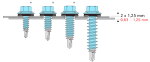
The limits are reached when the required sheet thicknesses become uneconomical or the deflections are too great. Fastening also becomes a problem with high tensile forces: the thin sheets can no longer be sufficiently anchored with the required screw spacing.
Warning signals for insufficient load-bearing capacity:
- Required spans above manufacturer's specifications
- Deflections over L/200
- Sheet thicknesses over 1.25 mm required
- Very narrow fixing distances required
- Susceptibility to vibration in windy conditions
Alternative solutions for higher loads
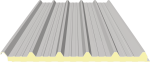
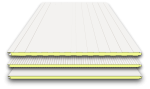
When the load-bearing capacity of trapezoidal sheets reaches its limits, more efficient alternatives are available. Roof panels combine two thin steel sheets with an insulating core and thus achieve significantly higher load-bearing capacities with better thermal insulation.
This construction method utilises the composite effect: the two cover layers act like the chords of an I-beam, while the insulating core transfers the shear forces. This results in high moments of inertia despite low material thicknesses.
Sandwich panels as a statically superior solution
Thanks to their composite effect,sandwich panels achieve a significantly higher load-bearing capacity than simple trapezoidal sheets. A 100 mm thick sandwich panel can bridge spans of up to 12 m with appropriate dimensioning - while at the same time providing excellent thermal insulation with U-values from 0.25 W/m²K depending on thickness. For wall applications, wall panels offer the same structural advantages with additional optimised fastening. Panels can be manufactured up to a length of 21 metres.
Structural advantages of sandwich panels:
- High bending stiffness due to large cross-sectional spacing
- Minimal deflection even with large spans
- Integrated thermal insulation reduces thermal bridges
- Even load distribution across the entire panel width
- Excellent ratio of dead weight to load-bearing capacity
When the change is worthwhile
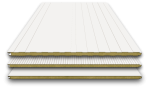
Switching to sandwich panels is particularly worthwhile for demanding projects with high static or energy requirements. The additional costs are amortised through savings on the substructure, better insulation values and a longer service life. For special safety requirements, fire protection panels with a rock wool core also offer the highest fire resistance classes.
Decision criteria for sandwich panels:
- High thermal insulation standards required
- Reduced substructure required
- Short construction time for large areas
- Combined requirements for statics and energy efficiency
Conclusion: While trapezoidal sheets are sufficient for simple applications, sandwich panels offer the statically and energetically superior solution for demanding construction projects. We will be happy to advise you on the optimum product choice for your project.
Do you need expert advice on load-bearing capacity calculations? Contact our experts - we will help you find the optimum solution for your structural requirements.
Last updated Nov 2025
Location and yard in Europe

From 10 locations, we can deliver across Europe